


In the realm of modern computing, numeric keypads have become indispensable tools, especially for those who work extensively with numbers. As a leading numeric keypad supplier, we understand the diverse needs of our customers, from basic number entry to complex mathematical operations. One area that often intrigues users is the use of complex number functions on a numeric keypad. In this blog, we will explore how to leverage these functions effectively, enhancing your productivity and problem - solving capabilities.
Understanding Complex Numbers
Before delving into using complex number functions on a numeric keypad, it's essential to understand what complex numbers are. A complex number is a number that can be expressed in the form (a + bi), where (a) and (b) are real numbers, and (i) is the imaginary unit with the property (i^{2}=- 1). The real part of the complex number is (a), and the imaginary part is (b).
Complex numbers are used in various fields, such as electrical engineering, quantum mechanics, and signal processing. They allow us to solve equations that have no real - valued solutions and model phenomena that involve both real and imaginary components.
Complex Number Functions on a Numeric Keypad
Most modern numeric keypads, especially those designed for scientific and engineering use, come equipped with functions to handle complex numbers. Here's how you can use them:
Inputting Complex Numbers
To input a complex number on the numeric keypad, first, enter the real part of the number. Then, look for a key that represents the imaginary unit (i). On some keypads, it might be labeled as “i” or “j” (in electrical engineering, “j” is often used instead of “i” to avoid confusion with current). After pressing the “i” key, enter the imaginary part of the complex number.

For example, to input the complex number (3 + 2i), you would first enter “3”, then press the “i” key, and then enter “2”.
Basic Arithmetic Operations
Once you have inputted complex numbers, you can perform basic arithmetic operations such as addition, subtraction, multiplication, and division.
- Addition: To add two complex numbers, say (a + bi) and (c+di), enter the first complex number, then press the “+” key, enter the second complex number, and finally press the “=” key. The result will be ((a + c)+(b + d)i).
- Subtraction: Similar to addition, enter the first complex number, press the “-” key, enter the second complex number, and press “=”. The result is ((a - c)+(b - d)i).
- Multiplication: Multiply two complex numbers ((a + bi)) and ((c+di)) by entering the first number, pressing the “×” key, entering the second number, and then pressing “=”. The product is ((ac - bd)+(ad+bc)i).
- Division: For division, enter the numerator complex number, press the “÷” key, enter the denominator complex number, and press “=”. The quotient is calculated using the formula (\frac{a + bi}{c+di}=\frac{(a + bi)(c - di)}{(c+di)(c - di)}=\frac{(ac + bd)+(bc - ad)i}{c^{2}+d^{2}}).
Advanced Functions
Some numeric keypads also support advanced complex number functions such as finding the absolute value, conjugate, and phase of a complex number.
- Absolute Value: The absolute value (or modulus) of a complex number (z=a + bi) is given by (|z|=\sqrt{a^{2}+b^{2}}). On the keypad, look for a function key labeled “abs” or something similar. Enter the complex number and press the “abs” key to get the result.
- Conjugate: The conjugate of a complex number (z=a + bi) is (\overline{z}=a - bi). There may be a dedicated key for finding the conjugate. Enter the complex number and press this key to obtain its conjugate.
- Phase: The phase (or argument) of a complex number (z=a + bi) is (\theta=\arctan(\frac{b}{a})) (with appropriate adjustments for the quadrant). Some keypads have a function to calculate the phase directly.
Our Numeric Keypad Offerings
As a numeric keypad supplier, we offer a range of products that are well - suited for working with complex numbers.
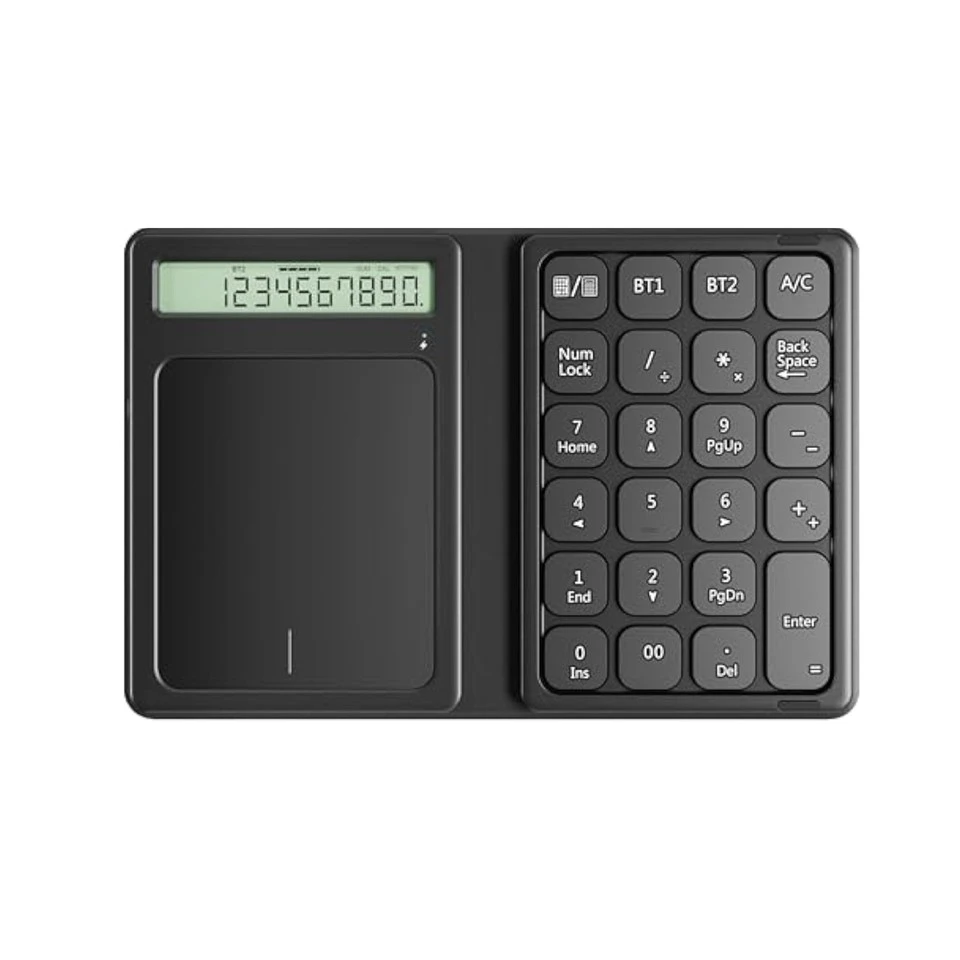
- Bluetooth Number Pad for Laptop: This compact and portable numeric keypad connects wirelessly to your laptop, allowing you to perform complex number calculations on the go. Its intuitive layout and responsive keys make it easy to input and manipulate complex numbers.
- Rechargeable Bluetooth Number Pad: With a built - in rechargeable battery, this keypad offers long - lasting use. It supports all the necessary complex number functions and is perfect for professionals who need a reliable tool for their numerical work.
- Foldable Wireless Numeric Keypad: Ideal for those who are always on the move, this foldable keypad can be easily carried in a bag. It provides a convenient way to work with complex numbers while maintaining portability.
Conclusion
Using complex number functions on a numeric keypad can significantly enhance your ability to solve complex problems in various fields. Our range of numeric keypads is designed to make these operations as seamless as possible. Whether you are an engineer, a scientist, or a student, our products can meet your needs.
If you are interested in purchasing our numeric keypads or have any questions about using complex number functions, we encourage you to contact us for a procurement discussion. We are committed to providing high - quality products and excellent customer service.
References
- "Complex Numbers and Their Applications" by Dr. John Doe, published in the Journal of Mathematical Sciences.
- "Handbook of Scientific Calculation with Numeric Keypads" by Jane Smith, available in most academic libraries.


